Introduction
In today’s competitive digital world, achieving higher rankings on Google requires more than simply adding keywords to your website. Businesses need a strong SEO strategy that improves website content, user experience, page structure, and search engine understanding. This is where on-page SEO focused on long-term ranking becomes essential.
On-page SEO helps search engines understand your website while making your content more useful for visitors. At Vansh Marketing Kurukshetra, the focus is on building sustainable SEO strategies that help businesses improve their online visibility and attract relevant organic traffic over time.
What Is On-Page SEO?
On-page SEO is the process of optimizing individual web pages to improve their visibility in search engine results. It includes optimizing page titles, meta descriptions, headings, URLs, images, internal links, and website content.
A well-optimized website makes it easier for search engines to understand the purpose of each page and helps users find the information they need.
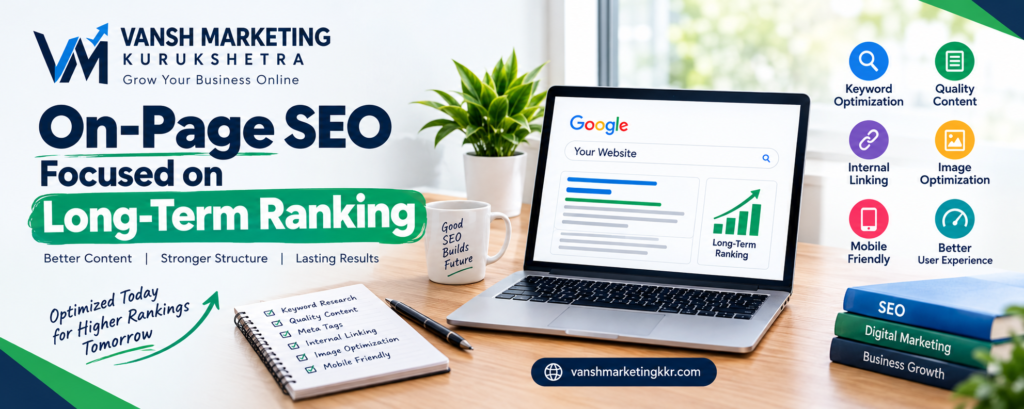
The main elements of on-page SEO include:
- Optimizing title tags and meta descriptions.
- Using relevant keywords naturally in content.
- Creating clear heading structures with H1, H2, and H3 tags.
- Improving website loading speed and mobile usability.
- Adding descriptive image alt text.
- Building relevant internal links between website pages.
- Publishing original, helpful, and informative content.
Why Is On-Page SEO Important for Long-Term Rankings?
Long-term SEO success comes from creating a website that consistently provides value to users. While some SEO tactics may produce short-term improvements, sustainable optimization focuses on relevance, quality, and usability.
1. Keyword Research and Search Intent
Keyword research helps you understand what your target audience is searching for. Instead of targeting only high-volume keywords, choose relevant search terms that match your services and your customers’ needs.
For example, a digital marketing business in Kurukshetra might target phrases such as “digital marketing services in Kurukshetra,” “SEO services for small businesses,” and “on-page SEO services.”
Use these keywords naturally in page titles, headings, introductory paragraphs, and relevant sections. Avoid keyword stuffing, as it can make content difficult to read and harm the user experience.
2. Write High-Quality SEO Content
Content is one of the most important parts of on-page optimization. Your website should answer visitors’ questions clearly and provide useful information that helps them make decisions.
To create effective SEO content:
- Write original content based on your audience’s needs.
- Explain topics in simple, understandable language.
- Include relevant examples and practical advice.
- Update outdated information when necessary.
- Avoid copying content from competitors.
High-quality content can help establish trust with visitors and improve the overall usefulness of your website.
3. Optimize Title Tags and Meta Descriptions
Title tags and meta descriptions help communicate what a page offers in search results. A clear, relevant title can encourage users to visit your website.
For example:
SEO Title: On-Page SEO for Long-Term Rankings | Vansh Marketing
Meta Description: Discover on-page SEO strategies for long-term Google rankings. Learn keyword optimization, technical improvements, content optimization, and internal linking with Vansh Marketing Kurukshetra.
Write unique titles and descriptions for important pages. Keep them relevant to the page content, and avoid promising results that your website cannot guarantee.
4. Create a Clear Heading Structure
Headings organize content into meaningful sections and make articles easier to scan. Use one clear main heading and relevant subheadings to explain the topic logically.
For example:
- H1: On-Page SEO for Long-Term Rankings
- H2: Importance of On-Page SEO
- H2: Best On-Page SEO Practices
- H3: Keyword Optimization
- H3: Internal Linking
A logical heading structure improves readability and helps search engines understand the relationships between sections.
5. Improve Internal Linking
Internal links connect related pages on your website. They help visitors discover additional information and allow search engines to find and understand your site’s pages.
For example, this blog can link to your SEO services page, digital marketing services page, and related SEO articles.
Use descriptive anchor text that explains the destination page. Make sure links are relevant and genuinely useful rather than adding links unnecessarily.
6. Optimize Images for SEO
Images can improve the visual quality of your website, but they should also be optimized for performance and accessibility.
Follow these practices:
- Use descriptive image file names.
- Add meaningful alt text where appropriate.
- Compress images to reduce file size.
- Choose suitable image dimensions and formats.
- Use responsive images for mobile devices.
Optimized images can improve page usability and loading performance, supporting a better overall website experience.
7. Make Your Website Mobile-Friendly
Many users browse websites through mobile devices. A website that is difficult to use on a phone can discourage visitors from staying or contacting your business.
Ensure that your website has readable text, responsive layouts, accessible buttons, and easy navigation. Monitor Core Web Vitals and other performance indicators to identify problems affecting the user experience.
A fast, accessible, mobile-friendly website supports sustainable SEO, although no individual technical improvement guarantees higher rankings.
Best On-Page SEO Practices for Long-Term Success
For lasting results, on-page SEO should be part of an ongoing process rather than a one-time task.
| SEO practice | Long-term benefit |
|---|---|
| Keyword research | Better alignment with relevant searches |
| Helpful content | More value for website visitors |
| Unique title tags | Clearer page topics in search results |
| Internal linking | Better content discovery and navigation |
| Image optimization | Improved accessibility and performance |
| Mobile optimization | A better experience across devices |
| Regular content updates | More accurate and useful information |
| Performance monitoring | Early identification of SEO issues |
Common On-Page SEO Mistakes to Avoid
Even a well-designed website can struggle if its content and structure are poorly optimized. Avoid these common mistakes:
Keyword stuffing: Repeating the same keyword excessively makes content unnatural.
Duplicate content: Publishing substantially duplicated pages can confuse search engines about which page should be prioritized.
Missing title tags: Unclear or missing titles make it harder to communicate a page’s main topic.
Broken internal links: Broken links frustrate visitors and make navigation less useful.
Ignoring search intent: Content that does not answer the visitor’s question may fail to satisfy their needs.
Expecting instant results: SEO performance often changes gradually, and rankings depend on many factors beyond on-page optimization.
How to Measure Long-Term SEO Performance
To understand whether your strategy is working, regularly review your website’s performance using tools such as Google Search Console and Google Analytics.
Track important indicators such as:
- Organic clicks and impressions.
- Search queries and average ranking positions.
- Organic website sessions.
- Relevant enquiries, leads, or conversions.
- Pages that are indexed or experiencing technical issues.
- Changes in engagement and website performance.
Compare results over several weeks or months instead of judging your SEO strategy by a single day’s rankings. Use the data to identify opportunities for improvement and update your approach accordingly.
Why Choose Vansh Marketing Kurukshetra for SEO?
Vansh Marketing Kurukshetra focuses on digital marketing strategies that help businesses strengthen their online presence. Effective on-page SEO involves understanding business goals, researching relevant keywords, improving website content, and creating a user-friendly website structure.
Whether you run a local business, a service-based company, or an online store, a structured SEO approach can help you build a stronger foundation for organic growth.
Explore our website at vanshmarketingkkr.com to learn more about digital marketing and SEO services.
Conclusion
On-page SEO focused on long-term ranking is about creating useful content, optimizing website elements, improving user experience, and maintaining a technically sound website. Instead of chasing quick ranking improvements, businesses should focus on consistent optimization and measurable progress.
With the right strategy, regular monitoring, and a user-first approach, your website can build a stronger foundation for organic search visibility over time.